MSP Profitability
Feature Adoption Won't Save Your Margins. This Will
Discover why measuring service gross margin, not feature adoption, is crucial for MSP profitability. Learn how to optimize your service desk...
Growth exposes what your service model is made of.
In the early days, effort hides the cracks. Small teams compensate through hustle. Everyone knows the clients personally. Knowledge lives in conversations and memory. It works—until it doesn’t.
As the client base expands, the cracks widen. Escalations multiply. Response times stretch. Senior engineers become a permanent safety net rather than a strategic resource. Burnout rises quietly, and customers start repeating themselves—to different technicians, on different tickets, about the same problem.
Revenue may be growing. Predictability isn’t.
And without predictability, margins tighten, churn risk climbs, and valuation stalls, leadership stops building and starts firefighting.
The problem isn’t talent, effort, or tooling. It’s structural. Most MSPs are trying to scale a service model designed for a ticket-driven era—one where capacity only grew when headcount did. That model created growth once. Today, it creates strain.
The next stage of service delivery isn’t about adding more layers to the same structure. It’s about replacing the structure entirely.
Every MSP operates inside a service delivery model, even if they’ve never named it.
It’s the invisible structure that determines:
It organizes people, process, technology, and metrics into something that’s supposed to deliver consistent outcomes.
And most of those models were built long before AI became a meaningful operational layer.
That’s the tension — we’re trying to scale modern expectations on top of legacy architecture.
Before we go deeper, it’s worth acknowledging the landscape most MSPs are operating in today. Over time, service desks evolved into a mix of structures:
Each of these emerged to solve a scaling problem at a specific moment in time. But most were designed to manage ticket flow — not compound intelligence. As volume increases, these models tend to add layers, handoffs, and complexity rather than clarity.
Most legacy models fall into one of these six categories:
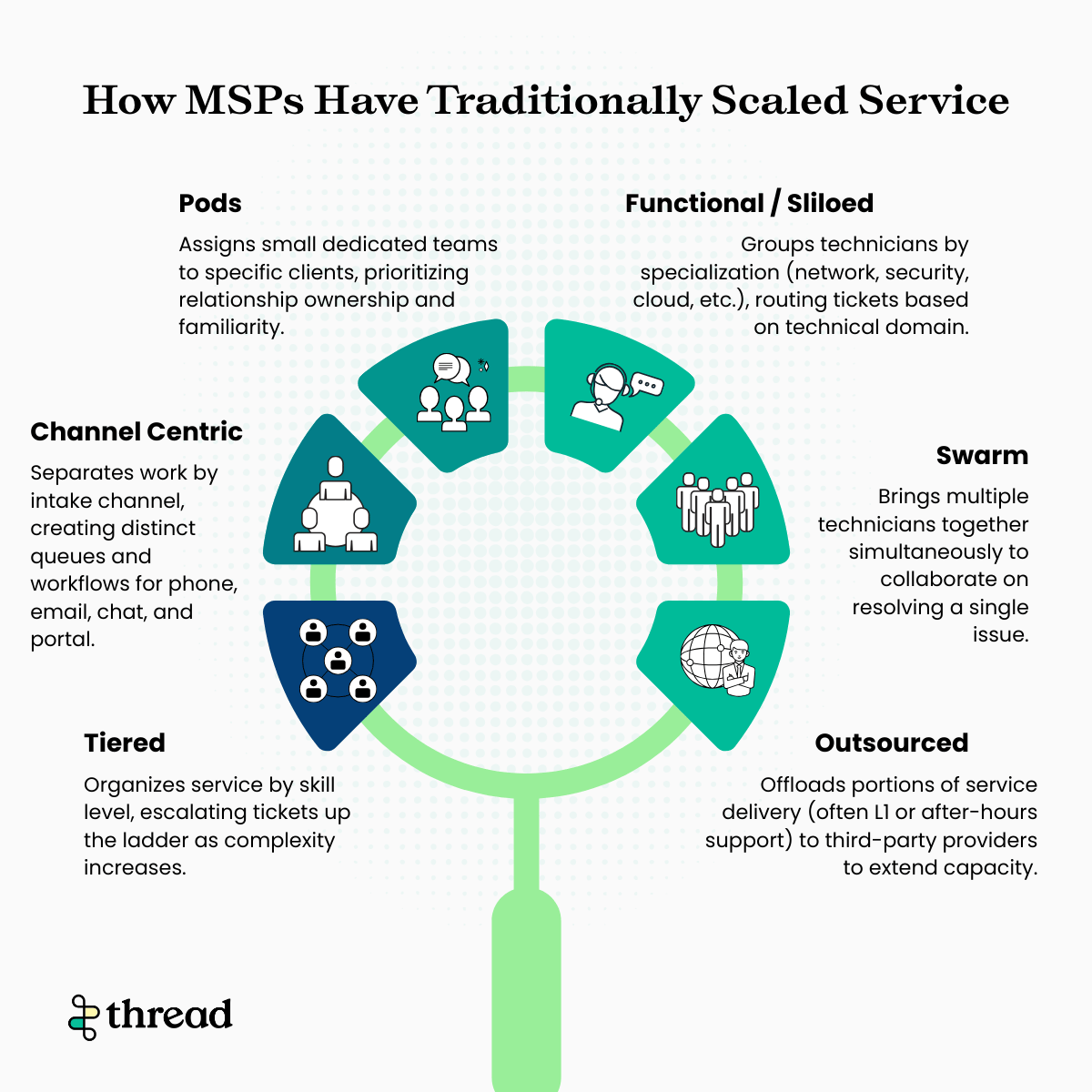
No matter the structure, the gravitational center is usually the same: tickets, queues, and SLA compliance.
Let’s dig a little deeper into the most common ones.
The L1 / L2 / L3 structure was built for efficiency and cost control.
Entry-level techs handle the volume, escalations move up the ladder and specialists intervene when needed.
On paper, it’s clean, but in practice, it creates restarts.Each escalation is a handoff, and each handoff is a point of friction. Each friction point increases the chance the customer has to repeat themselves. The model optimizes for resolution time and SLA performance. It does not optimize for continuity of experience.
As ticket volume increases, the model doesn’t become more intelligent, it becomes more layered.
Scaling within this structure means adding more tiers, more routing rules, more oversight.
Many MSPs divide service by intake channel:
Phone / Email / Chat / Portal
Each has its own queue, its own workflow and sometimes even its own team.
Internally, this can feel orderly but customers don’t experience service in channels. To them, it’s one conversation.
When they switch channels, continuity often breaks. History and context get lost. Ownership becomes unclear.
Pods attempt to solve fragmentation by assigning small teams to specific clients. It’s relationship-driven. Ownership-focused. Often beloved by customers.
But it scales by adding headcount.
Consistency depends on individuals. Knowledge lives in people’s heads. When someone leaves, continuity leaves with them.
The model can be strong — but it’s not structurally intelligent. It’s structurally dependent.
Across these models, one thing remains constant, the ticket is the organizing unit.
But customers don’t care about tickets, they experience outcomes.
And that mismatch between how MSPs organize service and how customers experience it and represents is where scaling starts to break.
If legacy models organize around tickets, intelligent service delivery organizes around experience and intelligence.
1. Customer-Obsessed Experience
Legacy models optimize for SLA compliance. Intelligent models optimize for customer experience. That means continuity over handoffs. Context over speed metrics. Outcomes over ticket closure. The customer is no longer at the edge of the system. They are at the center of it.
2. Assistive AI
Assistive AI supports technicians in real time.
It summarizes history. Surfaces relevant knowledge. Drafts communication. Reduces repetitive effort. Instead of technicians hunting for context, context comes to them. Throughput increases without adding layers.
3. AI Routing
Routing is no longer manual, static, or queue-based. AI interprets intent, priority, and context before work ever reaches a technician. The right work lands in the right place the first time.
4. Agentic AI
Agentic AI goes beyond assistance. It can triage, gather missing information and execute defined resolutions. Not every task needs to be escalated. Not every request needs to consume human time. This is where intelligence begins to scale.
5. Thread Inbox (Service OS)
If legacy models revolve around the ticket, intelligent models revolve around the Thread.
The inbox becomes the operating system of service. One continuous conversation across time, channels and technicians.
6. Thread Intelligence
In legacy service models, data is stored. In intelligent service models, data compounds.
Thread Intelligence is the learning layer of the system. It captures what happened, why it happened, and how it was resolved, and makes that information usable in real time.
Patterns inform routing. Resolutions strengthen knowledge. Repeated issues surface automatically. Automation expands based on evidence, not guesswork.
The system improves because it has memory. It’s the difference between processing tickets and building intelligence.
Every service delivery model eventually reveals what it was designed to optimize.
But none of them were designed to optimize intelligence and that’s why scaling them feels like such a lift. The only way to grow is to add layers, add rules, add people.
The next phase of service delivery isn’t about squeezing more efficiency out of legacy structures. It’s about replacing the center of gravity.
In the next post, we’ll go beyond the framework and into execution — how the six pillars work together in practice, what actually changes day to day, and what it looks like when service becomes an intelligent system instead of a ticket machine.
Because scaling doesn’t require more complexity.
It requires a different foundation.
Discover why measuring service gross margin, not feature adoption, is crucial for MSP profitability. Learn how to optimize your service desk...
AI-native service desks rely on intelligent routing. Learn how MSPs eliminate ticket bottlenecks, improve consistency, and accelerate service...
Swivel Chair Syndrome wastes time and kills efficiency. Discover how a unified service desk can streamline your MSP operations and boost productivity.