Phone support is not broken because clients still call.
Clients call because the issue matters. Because something is urgent. Because they are stuck. Because typing the problem into a portal feels slower than picking up the phone.
The real problem is not the phone.
The real problem is that most MSP service desks still manage phone support like it is separate from the rest of service delivery.
Tickets have workflows. Chat has structure. Email has queues. Automations have triggers. Reporting has dashboards.
But the phone? The phone often still depends on whoever answers, how much they capture, how fast they type, whether voicemail gets checked, and whether the next person can understand what happened.
That is where MSP phone support quality breaks down.
Not in one dramatic moment. In small operational gaps repeated across hundreds of calls: missed context, inconsistent notes, delayed triage, unclear ownership, weak visibility, and manual follow-up.
For MSP service desk leaders, this is not just a call-handling issue. It is a service delivery issue. And increasingly, it is a customer experience issue.
What causes MSP phone support quality to break down?
MSP phone support quality breaks down when calls are handled inconsistently, documented manually, routed unevenly, or disconnected from the rest of the service desk workflow.
The result is predictable: slower triage, weaker visibility, unnecessary technician interruptions, inconsistent technical support, and a less reliable client experience.
This is one of the most common MSP service delivery challenges because the phone is both high-value and high-friction. It gives technicians rich context, but only if that context gets captured. It creates urgency, but not always clarity. It gives clients a human channel, but it can quickly become the least measurable part of the service desk.
Here are the seven places MSP phone support quality usually starts to fall apart.
1. Calls interrupt service delivery
The phone does not care what your team is already doing.
It rings in the middle of escalations, dispatch reviews, project work, documentation, remote support sessions, and the thousand tiny decisions that keep a service desk moving.
That interruption is expensive.
A technician has to stop, listen, understand, calm the client down, ask the right questions, identify impact, make a judgment call, document the conversation, and then somehow return to whatever they were doing before.
That is not just multitasking. That is service delivery fragmentation.
For service desk leaders, the cost shows up in subtle ways:
- Tickets sit idle while technicians handle live calls
- Notes get written after the fact
- The original task loses momentum
- Priority decisions happen under pressure
- The caller experience depends on who happened to answer
This is one of the reasons call center management for IT is so difficult. Traditional call center logic assumes the phone is the work. MSP service desks are different. The phone is usually the front door to work that must then be triaged, documented, routed, and resolved across multiple systems.
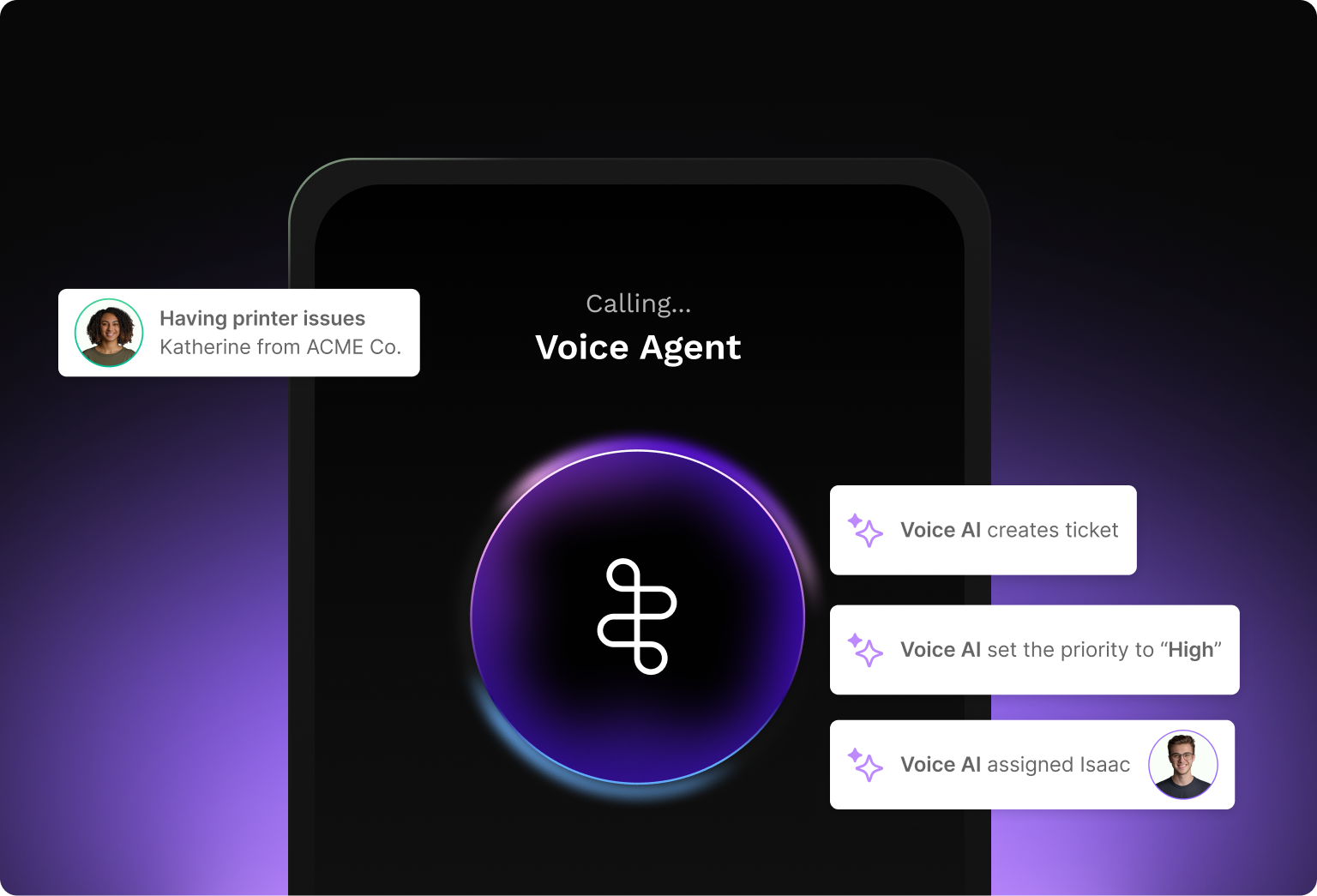
Thread Voice AI helps reduce that operational drag by capturing calls from the first ring, documenting what matters, and turning the conversation into structured service work. The service desk still owns the outcome, but the intake process stops depending entirely on the memory and availability of one technician.
That is the first step toward better MSP phone support quality: stop letting calls arrive as chaos.
2. Voicemail creates a blind spot
Voicemail is familiar, which makes it easy to underestimate.
A client leaves a message. Someone has to check it. Someone has to listen. Someone has to replay the unclear part. Someone has to create the ticket. Someone has to decide whether the issue is urgent. Someone has to follow up.
That is not a process. That is a pile of hidden work.
And because voicemail sits outside the normal flow of service delivery, it creates blind spots for leaders.
How many calls were missed? Which clients are leaving the most messages? Which after-hours issues are urgent? Which voicemails became tickets? Which ones waited too long? Which ones never became visible until a client followed up again?
When the phone becomes a holding pen, MSP customer experience suffers.
The impacts of Voice AI at CCS Technology is a good example of the problem and the fix. CCS replaced voicemail chaos with AI-powered ticketing, improving accuracy, visibility, and customer experience by turning a workflow that had always existed into something cleaner and more consistent. As the story puts it, the best use of AI is sometimes not doing something brand new. It is finally fixing something old.
That is exactly the point.
Voicemail is old. The need behind it is not.
Clients still need a way to be heard when technicians are unavailable. But the output should not be an audio file sitting in a folder. It should be a structured ticket with a transcript, summary, urgency, and next step.
Thread Voice AI helps make that possible.
3. Call notes depend on memory
A phone call contains more context than almost any other support channel.
Tone. Urgency. Frustration. Business impact. History. Confusion. Workarounds. Deadlines. Names. Locations. Devices. The little clues that tell an experienced technician whether something is routine or about to become a fire.
But most of that context is fragile.
If the technician does not write it down, it disappears. If they summarize too quickly, it gets flattened. If they are interrupted, it gets distorted. If the ticket gets created later, it becomes a memory exercise.
That is a bad foundation for consistency in technical support.
A call that included five important details can become a ticket that says, “User called about printer issue.”
Technically true. Operationally useless.
Thread Voice AI helps by capturing and transcribing the conversation, then turning it into complete and accurate ticket notes. Thread’s Voice AI launch describes this directly: incoming calls are answered instantly, calls are logged, tickets are updated with complete notes, and nothing gets lost between the conversation and the service desk.
That matters because better notes are not just nicer notes.
Better notes mean better triage.
Better triage means faster resolution.
Faster resolution means happier clients.
This is where AI earns its place in the service desk. Not by sounding impressive, but by making the basics more reliable.
4. Triage varies by technician
Every service desk leader knows this problem.
Give the same call to three different people and you may get three different tickets.
One person captures the affected user, location, device, and impact. Another captures only the symptom. One marks it urgent. Another leaves it normal priority. One routes it to the right team. Another sends it to the person who usually handles that client.
That is not because technicians are careless.
It is because consistency is hard when people are busy, calls are live, and decisions happen under pressure.
This is one of the most persistent MSP service delivery challenges. Service leaders can write the playbook, train the team, and define the standards, but phone intake still depends on human judgment in the moment.
And human judgment under load varies.
The downstream effects are real:
- SLA risk gets hidden inside poorly prioritized tickets
- Dispatchers spend time cleaning up intake
- Clients repeat themselves
- Escalations happen later than they should
- Reporting becomes noisy because categorization is inconsistent
Thread has written about this same problem in routing: when assignment depends on manual judgment, one of the most important service delivery decisions is being made in the most fragile way possible, under load.
Voice AI helps by standardizing the intake layer. It can identify urgency, generate ticket titles, categorize work, suggest priority, and route issues more intelligently based on the actual conversation. Thread’s Voice AI launch notes that administrative work such as ticket titles, categories, priorities, resolution summaries, and time entries can be handled automatically.
This does not remove human judgment.
It gives human judgment a cleaner starting point.
5. After-hours and overflow support are fragile
After-hours support reveals the strength of your system.
During business hours, people can compensate for messy workflows. A dispatcher can ask a question. A tech can clarify. A manager can step in. Someone can check the queue and catch what almost slipped.
After hours, the system has to work.
If the fallback is voicemail, urgent issues can wait. If escalation rules are unclear, the wrong person gets contacted. If notes are thin, the on-call technician starts cold. If the client does not know what happens next, the experience feels uncertain.
That is a problem for MSP customer experience, but it is also a problem for team sustainability.
Nobody wants to be on call for a system that creates mystery.
Remote support optimization is not just about better tools for remote sessions. It is about making the entire path into support cleaner, especially when the team is distributed, unavailable, or working outside normal hours.
Thread Voice AI helps with after-hours and overflow by answering calls when technicians cannot, capturing the issue, creating structured tickets, and flagging urgent needs. The goal is not to pretend AI can solve every after-hours problem. The goal is to make sure every after-hours problem starts with better context.
That alone changes the experience.
-
For the client, it means the call did not disappear.
-
For the technician, it means they are not starting from a voicemail.
-
For the leader, it means after-hours support becomes visible enough to manage.
6. Phone support has no visibility layer
Service desk leaders manage what they can see.
Ticket volume. SLA performance. Response time. Resolution time. Utilization. CSAT. Escalations. Backlog. Agreement performance.
But phone support often lives outside that visibility layer.
Calls happen. Some become tickets. Some become notes. Some become voicemails. Some become “I talked to them earlier.” Some become tribal knowledge. Some become client frustration that only surfaces during the next QBR.
That is why phone support can become the most important channel leaders cannot actually manage.
A modern MSP should be able to answer questions like:
- Which clients call most often?
- Which issue types create repeat calls?
- Which calls consume the most technician time?
- Which after-hours patterns are emerging?
- Which clients are showing early signs of frustration?
- Which workflows are generating unnecessary phone volume?
- Which calls should have been routed differently?
Thread’s voice-enabled service desk POV speaks directly to this shift: modern MSPs are moving toward service desks that can turn calls into actionable data, surface call patterns, and reveal where automation can have the biggest impact.
That is the operational unlock.
Voice AI is not only about answering calls. It is about making phone support measurable.
When calls are captured, transcribed, summarized, categorized, and connected to tickets, the phone stops being a black box. It becomes another service channel that leaders can coach, report on, and improve.
That is what call center management for IT should look like inside a modern MSP.
7. Follow-up is too manual
Phone support does not end when the call ends.
Someone still has to clean up the ticket, assign the work, confirm next steps, notify the client, gather missing information, schedule the technician, update the record, and sometimes call back.
That follow-up layer is where quality often breaks down.
Not because the team does not care. Because the team is already moving to the next issue.
Manual follow-up creates predictable gaps:
- Clients wait for confirmation
- Tickets lack next steps
- Dispatchers chase missing details
- Technicians inherit unclear work
- Managers lack confidence in the queue
- The client experience depends on individual follow-through
This is where inbound and outbound voice start to belong in the same conversation.
If inbound Voice AI helps capture and structure the call, outbound Voice AI can help close the loop. It can support follow-up, confirm details, chase missing information, communicate status, and keep clients updated without adding more manual work to the service desk.
That matters because MSP customer experience is not only shaped by how quickly the phone is answered. It is shaped by what happens next.
A great intake experience followed by silence is still a poor service experience.
The future of voice in the MSP service desk is not just call answering. It is call workflow.
Inbound. Overflow. After-hours. Follow-up. Outbound.
All connected to the service desk. All visible. All easier to manage.
How Thread Voice AI improves MSP phone support quality
Thread Voice AI is built around a simple idea: phone calls should not disappear into memory, voicemail, or disconnected systems.
They should become structured, trackable service work.
Thread Voice AI helps MSPs:
- Answer incoming, overflow, and after-hours calls
- Capture the full call conversation
- Transcribe calls automatically
- Create and update PSA tickets
- Generate accurate notes and summaries
- Identify urgent issues in real time
- Categorize and prioritize work
- Reduce manual documentation
- Improve visibility into call patterns
- Give technicians better context before they start work
- Support better follow-up across inbound and outbound workflows
The broader promise is not “AI answers the phone.”
The promise is that voice becomes part of the service desk operating system.
That is a much bigger shift.
Because once phone calls are captured, structured, and connected to the PSA, service leaders can finally manage the channel with the same discipline they bring to tickets, chat, email, and automation.
What MSP service desk leaders should look for in a Voice AI solution
Voice AI is going to become a crowded category. The difference will not be whether a tool can talk.
The difference will be whether it actually improves service delivery.
MSP service desk leaders should look for Voice AI that can:
- Create and update PSA tickets
- Capture full call transcripts and summaries
- Detect urgency based on caller context
- Support overflow and after-hours workflows
- Respect service desk processes instead of creating a separate queue
- Improve consistency in technical support
- Provide visibility into call volume and call patterns
- Reduce technician interruptions
- Support inbound and outbound workflows
- Integrate with the systems MSPs already use
The test is simple.
Does it make the phone easier to manage?
Does it make the ticket better?
Does it make the technician faster?
Does it make the client feel more supported?
If the answer is no, it is probably just another layer of noise.
The bottom line
MSP phone support quality does not break down because the phone is outdated.
It breaks down because the phone is too often disconnected from the operating model of the service desk.
Calls arrive with urgency but without structure. They contain context but lose it quickly. They create tickets but not always good ones. They shape customer experience but often escape measurement.
That is the gap service desk leaders need to close.
Thread Voice AI helps close it by turning calls into structured, visible, trackable service work. It captures the conversation, creates the ticket, identifies urgency, supports routing, and gives leaders a clearer view of what is actually happening on the phone.
The phone is not going away.
But the old phone workflow should.
FAQs
What is MSP phone support quality?
MSP phone support quality is the consistency, accuracy, responsiveness, and customer experience of phone-based support. It includes how quickly calls are answered, how well issues are documented, how accurately tickets are triaged, and how reliably the service desk follows up.
Why does MSP phone support quality break down?
MSP phone support quality breaks down when calls are missed, documented manually, triaged inconsistently, routed poorly, or disconnected from PSA workflows. These gaps create delays, incomplete tickets, SLA risk, and inconsistent customer experiences.
What are the biggest MSP service delivery challenges with phone support?
The biggest MSP service delivery challenges with phone support include technician interruptions, voicemail delays, inconsistent triage, poor documentation, limited visibility, after-hours coverage gaps, and manual follow-up.
How can MSPs improve consistency in technical support?
MSPs can improve consistency in technical support by standardizing intake, capturing complete call context, using structured ticket creation, applying consistent priority rules, and making call data visible to service desk leaders.
How does Voice AI help with call center management for IT?
Voice AI helps with call center management for IT by answering calls, transcribing conversations, creating tickets, identifying urgency, summarizing issues, and giving leaders visibility into call volume, repeat issues, and service patterns.
How does phone support affect MSP customer experience?
Phone support affects MSP customer experience because clients often call when issues are urgent or confusing. If calls are missed, poorly documented, or followed up slowly, clients feel ignored. If calls are captured and handled consistently, clients feel heard and supported.
What is remote support optimization for MSPs?
Remote support optimization means improving the way MSPs deliver support across distributed teams, remote users, and multiple service channels. For phone support, it means making sure calls are captured, documented, routed, and followed up consistently, even when technicians are remote or unavailable.
Can Voice AI replace voicemail for MSPs?
Yes. Voice AI can replace traditional voicemail by answering overflow and after-hours calls, collecting the caller’s issue, transcribing the conversation, and creating a structured PSA ticket instead of leaving an audio file for someone to process later.
Can Voice AI support outbound MSP workflows?
Yes. Outbound Voice AI can help MSPs follow up on open tickets, confirm missing information, communicate status, and proactively reach clients without adding more manual work to the service desk.