Thready Awards
Announcing the Recent Thready Award Winners
Celebrating the 2025 Thready Award winners for innovative AI and automation in service desks, highlighting excellence in inbox transformation,...
It starts as a routine ticket: "Computer is slow." Your dispatcher glances at the queue, picks a category that seems close enough, sets the priority to Medium, and routes it to the general support team. Forty-five minutes later, a tech realizes it should've gone to the network team. Re-routing happens. The client, who hasn't heard anything calls in, frustrated. A coordinator steps in. Two techs are now looped in on a ticket that should've been resolved in one touch.
This isn't a horror story. For most MSPs, it's Tuesday.
The real problem is that inaccurate triage is invisible. It's baked into your workflow as "normal overhead" along with the rework, the SLA near-misses, the client callbacks and the corrupted reporting data. Most service managers never see it as a discrete problem with a discrete cost. They just accept slower resolution times, frustrated clients, and metrics that never quite add up.
Getting triage right isn't a nice-to-have. It's the single highest-leverage improvement you can make to your service desk—and the one most MSPs are ignoring.
The five fields that matter most in triage (title, category, priority, type, and subtype) are also the five fields most likely to be wrong when a human fills them out under pressure.
Why? It's not incompetence. It's conditions. Techs are rushing during peak volume. Client descriptions are vague ("it's broken" is not a category). Standards drift across teams. A ticket that would be Priority 2 for one dispatcher is Priority 3 for another. And when someone's juggling thirty tickets before 10am, "good enough" becomes the default.
The downstream effects compound fast:
Let's put numbers to it. A mid-sized MSP handling 150 tickets per day with a 25% mis- categorization rate is dealing with roughly 37 misfiled tickets daily. If each one requires just 15 minutes of rework—re-routing, re-categorizing, client communication—that's over 9 hours of wasted tech time every single day. At an average burdened rate of $75/hour, you're looking at nearly $675 in daily rework cost, or roughly $170,000 a year.
And that's the conservative estimate. It doesn't account for:
Now flip it: what does 96% triage accuracy look like on those same numbers? That's fewer than 6 misfiled tickets a day. It's the difference between a service desk that runs and one that scales.
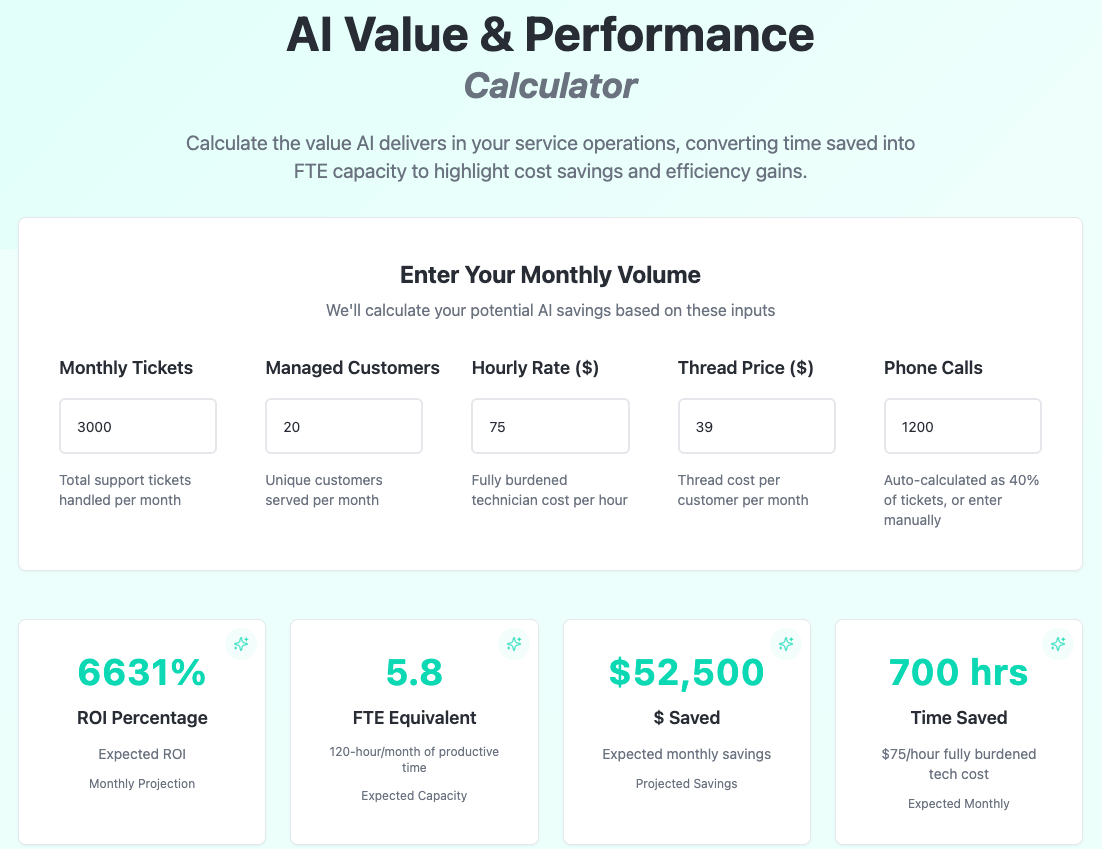
Schedule time to have your numbers plugged into Thread's ROI calculator to see what inaccurate triage is actually costing your practice.
Thread's automated triage doesn't just fix one field, it sets title, category, priority, type, subtype, resolution summary, and time entries automatically, from the moment a ticket comes in. And it does it out of the box. No months of training on your data. No manual rules engine to maintain. No code.
Before: A ticket arrives as "email not working." A dispatcher skims it, marks it as General > Software > Medium. It sits in the queue for 40 minutes before a tech opens it, realizes it's an Exchange issue affecting 12 users, and escalates it. Priority should have been Critical from the start. The SLA clock has been running the whole time.
After: The same ticket arrives. Thread reads the content, identifies the scope, and sets the category to Email > Exchange, priority to Critical, and routes it directly to the right team, before a human even looks at it. Time to first response drops. The SLA is met. The client never has to call in.
"But what about the other 4%?" Fair question. Edge cases exist—ambiguous tickets, unusual client environments, one-off issues that don't fit standard patterns. Thread flags these for human review rather than guessing wrong. And critically, accuracy improves over time as the system learns your environment. The 4% shrinks. The 96% grows.
The immediate ROI of accurate triage is obvious: fewer misfiled tickets, faster resolution, less rework. But the second-order effects are where MSPs really start to pull ahead.
Clean data compounds. When triage is accurate from intake, your reporting actually means something. Category breakdowns you can trust. Tech performance benchmarks that are fair. Client-specific issue patterns that let you get ahead of recurring problems before they become churn risks. If you've been making staffing or pricing decisions based on your current reporting, it's worth asking: how much of that data was built on a foundation of misfiled tickets?
The dispatcher role evolves. When AI handles the categorization grunt work, your dispatch team stops being ticket processors and starts being service strategists. They're reviewing exceptions, not triaging volume. They're escalating proactively, not reactively. That's a different, and more valuable job.
And tech morale? Nobody became an MSP technician to recategorize tickets all day. When the administrative noise is handled automatically, techs spend more time on actual technical work. That matters for retention in a market where good techs are hard to find and keep.
If your data is wrong at intake, everything downstream is compromised. Your reporting. Your SLA tracking. Your client conversations. Your billing. Accurate triage isn't a feature you add to a healthy service desk, it's the precondition for having a healthy service desk at all.
Most operational improvements at the service desk level take months to show results. Triage automation through Thread is live in 24 hours, not 6 months, and the accuracy is measurable from day one.
The triage tax is real. Most MSPs are just too used to paying it to notice.
See how Marco added 600+ billable hours and reduced the amount to time technicians spent on repetitive tasks by adding Thread to their stack
Calculate what inaccurate triage is costing your practice and see how Thread in action → [Schedule a consultation]
Celebrating the 2025 Thready Award winners for innovative AI and automation in service desks, highlighting excellence in inbox transformation,...
Discover how Model Context Protocols (MCPs) empower MSPs to enhance AI integration, streamline operations, and improve service delivery across their...
Discover how Managed Intelligence is transforming MSPs into strategic partners, delivering AI-driven insights and proactive solutions that set new...