MSP AI
What Agentic SOPs Actually Look Like in a Real MSP
Discover how agentic SOPs empower MSP teams to act decisively, improve response times, and enhance client satisfaction through structured autonomy.
Every time a new problem emerged over the last five years, MSPs did the logical thing: they bought a tool for it. Endpoint alert fatigue? New tool. Client communication chaos? New tool. Documentation scattered across shared drives? New tool.
The result is a stack that's grown well past 15 platforms for many shops, and a reality where half your technicians are only using a fraction of what you're paying for. Licenses sitting idle. Data siloed in apps that don't talk to each other. Techs alt-tabbing their way through every ticket.
The question for 2026 isn't "what else do we need?" It's "what's actually earning its keep?"
Here's the thing: the best MSP tech stacks aren't the biggest ones. They're the most connected. The value of any tool in your stack is ultimately a function of how well it integrates with everything else. A best-in-class RMM that doesn't feed your PSA cleanly is just a fancy dashboard. An AI tool that can't touch your documentation is solving half the problem.
This is a guide for MSP owners and operations leaders who want to take a hard look at their stack, cut what's bloat, reinforce what's essential, and build something that compounds in value over time.
Your Professional Services Automation platform is where the business runs. Tickets, time tracking, billing, SLA management — it all lives here. ConnectWise Manage, Datto Autotask, and HaloPSA are the platforms most MSPs are built on, and for good reason.
What's changed is what you should demand from them in 2026: open APIs, real-time data sync with the rest of your tools, and a data structure that's AI-ready. If your PSA is a black box (data goes in, reports come out, and nothing else can touch it) you're sitting on an asset you can't fully use.
Thread integration note: Thread integrates natively with ConnectWise Manage, Autotask, and HaloPSA, pushing triage data, time entries, and ticket updates in real time. No manual syncing. No stale data. The PSA stays current because the intelligence layer keeps it current.
The Remote Monitoring and Management layer is mature. Most MSPs are well-served by what they already have, and the market has largely consolidated. This isn't where your biggest opportunities lie in 2026.
What matters here is integration: does your RMM alert into your triage workflow, or does it create a separate silo your techs have to monitor? Proactive alerting only creates value if it leads to action — and action starts in the PSA.
Passwords, configurations, network diagrams, client-specific procedures — this is the knowledge that makes your team effective and your business resilient. IT Glue and Hudu are where most MSPs have landed.
The problem isn't usually the documentation itself. It's accessibility. Knowledge buried in a separate application that techs have to navigate to — while a client is waiting — is knowledge that doesn't get used. The goal is documentation that surfaces automatically, in context, when someone needs it.
This is where the stack gets interesting. The tools in this category don't replace your foundation, they make it dramatically more effective.
This is the category that's reshaped what's possible for MSPs. An AI service desk sits across your PSA, documentation platform, and communication channels and acts as the connective intelligence layer that ties them together.
Done well, it automates triage, surfaces knowledge at the right moment, enables AI-powered client communication, and gives you client intelligence that helps your team prioritize and respond faster. It's not a replacement for your techs, it's the layer that takes the repetitive, context-gathering work off their plates so they can focus on problems that actually need a human.
Thread is purpose-built for this. No-code setup. Deploys in 30 minutes. Integrates natively with your existing stack.
Coordinating tech availability with client scheduling is one of those problems that looks simple and isn't. The back-and-forth eats into resolution time in ways that don't show up cleanly on a dashboard but absolutely affect your client experience.
TimeZest integrates with Thread and your PSA to automate that coordination. When Thread triages a ticket that requires a scheduled appointment, TimeZest can automatically surface scheduling options to the client — removing an entire round of manual communication from the workflow.
The ability to trigger multi-step workflows across your stack without writing code is no longer a nice-to-have. It's what separates MSPs running lean from MSPs drowning in manual steps.
Rewst is the automation backbone for MSPs who want to connect their tools at a process level. When combined with Thread, the possibilities are real: a ticket comes in, Thread triages and categorizes it, Rewst kicks off a remediation workflow, the ticket gets resolved, time gets logged, and the client gets notified. Zero human touches for the right use cases.
Thread handles the service desk. Pia brings AI to the commercial side integrating sales, quoting, procurement. Together, they represent what the AI-native MSP operating model actually looks like: AI working across both the delivery and business development sides of the house, not just bolted onto one of them.
Where your clients reach you matters. If they have to log into a portal they barely remember, ticket submission rates drop and phone and email volume stays high.
Thread integrates natively with Microsoft Teams and Slack, turning the platforms your clients already use into fully functional service desk channels. A client sends a message in Teams, Thread captures it, triages it, creates the ticket, and either resolves it via AI agent or routes it to the right technician. No portals. No forms. No friction.
Knowing what to cut is as important as knowing what to keep. A few patterns show up consistently in over-invested MSP stacks:
Here's a simple framework for auditing what's in your stack, or evaluating what you're considering adding:
Run every tool in your current stack through these five questions. The answers will tell you what stays, what gets cut, and where the gaps are.
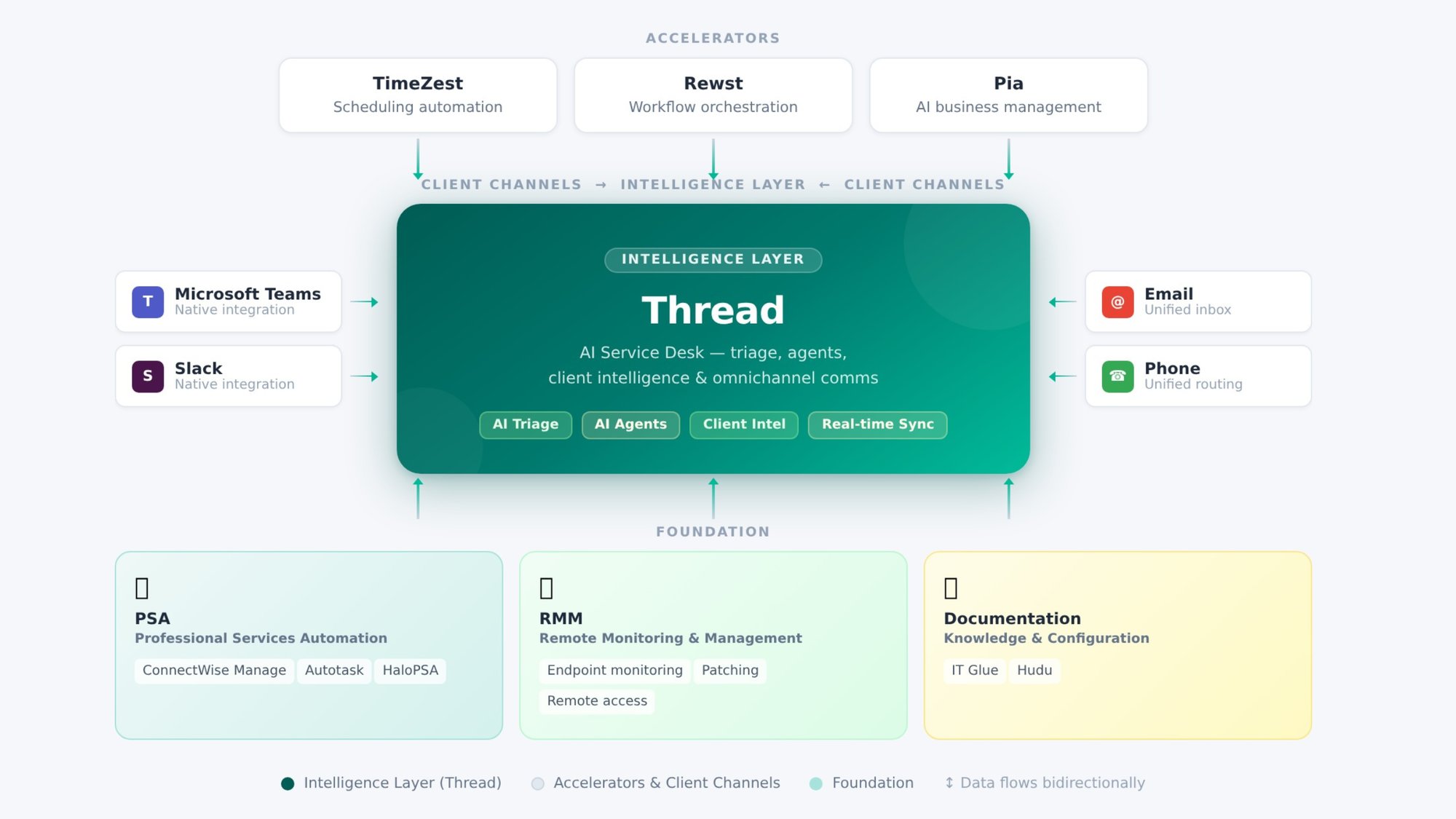
For most MSPs, the ideal stack in 2026 looks something like this:
Thread sits at the center of this picture not because it replaces everything else, but because it connects everything else. It's the layer that ensures data flows between platforms, knowledge is accessible in context, and AI fills the gaps that would otherwise require manual intervention. It makes every other tool in the stack perform better.
The modern MSP tech stack isn't about having the most tools. It's about having the right tools, deeply integrated, with AI connecting the dots between them.
Every platform in your stack should justify its place with measurable impact and a clear integration story. If it can't do both, it's a candidate for the cut list.
Thread was built to be the intelligence layer MSPs have been missing, the platform that sits at the center and makes everything else perform. Not another silo. A connector.
Discover how agentic SOPs empower MSP teams to act decisively, improve response times, and enhance client satisfaction through structured autonomy.
Discover why legacy service models can't scale and learn about the future of intelligent service delivery for MSPs, focusing on customer experience...
Discover how Rarity Solutions automated its dispatch role, achieving an 80% reduction in ticket handle time and enhancing operational efficiency.