But if you’ve ever rolled out something new and thought, “Why does it still feel slow?” there’s a good chance the problem isn’t the intelligence.
In the early days, effort
It’s the path.
Because in most service desks, work still moves through the same legacy funnel:
A request comes in → someone triages it → someone categorizes it → it lands in a queue → someone picks it up when they can → and if it’s misrouted, it starts over again.
That’s the part most teams accept as “just how service works.”
It’s also the part that quietly kills the customer experience.
The Old Model Doesn’t Fail Loudly. It Fails by Friction.
When tickets bounce between queues, it doesn’t look dramatic on a dashboard.
It looks like a few extra minutes here, a handoff there, a clarification message, a second technician getting pulled in.
But to the customer, it feels like they’re constantly repeating themselves, waiting through gaps they can’t see, and getting a new technician every time. It feels like the same issue keeps re-entering the system as if it were brand new.
In other industries, support can be treated as a cost center. In MSP-land, support is the product.
So when time dies in the funnel, it doesn’t just hurt efficiency. It hurts trust.
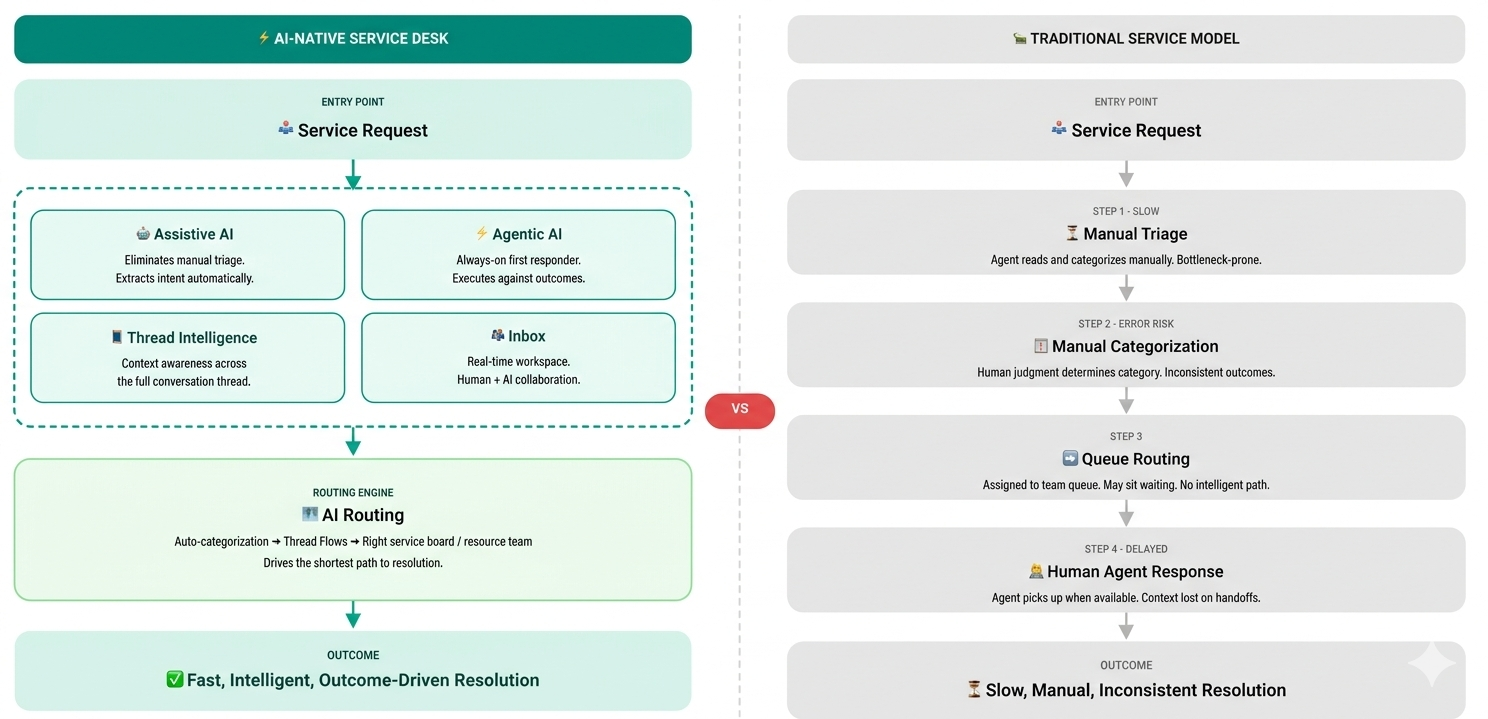
The AI-Native Service Desk Runs in Parallel. The Traditional One Runs in Line.
In the traditional service model, everything is sequential:
- Manual triage
- Manual categorization
- Queue routing
- Human response
- Slow, inconsistent resolution
Every step depends on the step before it. Every delay compounds.
In the AI-native model, multiple things fire at once:
- Assistive AI extracts intent and key details immediately
- Agentic AI acts as a first responder, gathering information or troubleshooting
- Thread Intelligence reads full context and surfaces what matters
- Inbox becomes the collaboration layer where humans and AI work in real time
That parallel engine is where the speed comes from.
But here’s the catch, all of that intelligence only creates leverage if it lands in the right place.
That’s why routing matters.
The Hidden Bottleneck: Routing Is Still a Human Judgment Call
When a ticket hits your service desk, how does it get to the right person?
When we asked our partners, the most common answer wasn’t rules. It wasn’t automation, and It wasn’t AI. It was: Someone manually assigns it.
That’s not a knock on dispatchers. It’s just reality.
Routing is one of the most important decisions in service delivery, and it’s still being made in the most fragile way possible: human judgment under load.
Which means:
- Two dispatchers may make different calls on the same issue
- Technicians cherry-pick work
- Tickets land in the wrong queue and wait
- Escalations reset context instead of building on it
The result isn’t just slower resolution, it’s inconsistency.
As Dennis Heiss, Director of Service Delivery at New Charter Technologies, put it during the session, “Speed is great, but the real promise is consistency — doing it right, every time.”
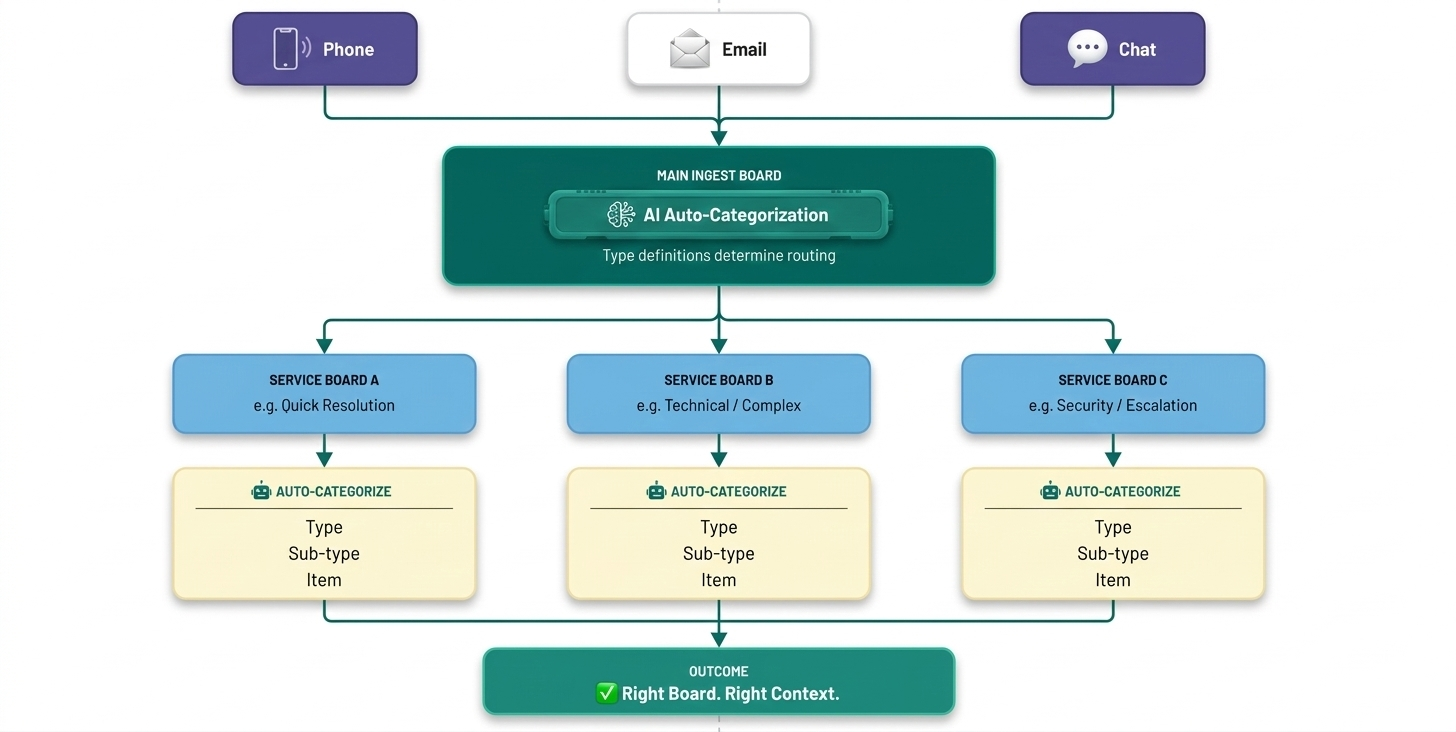
Stop Using Your Ingest Board to Describe the Issue
This is the practical shift that unlocks AI routing.
Most MSPs treat the first landing place (triage board, queue, or team) as a place to categorize issues using ITSM-style types, subtypes, and items. But that’s not what the ingest board is for.
The ingest board has one job, everything that lands there needs to leave it.
Instead of using that board to fully classify the issue, design it to answer a different question: Where should this go next?
That means your types on the ingest board are built around destination, not perfect categorization.
Quick resolution vs. complex.
Security/escalation vs. standard service.
Pod A vs. Pod B.
The AI isn’t being trained to label tickets like a library system. It’s being trained to route tickets like an operating system.
What AI Routing Looks Like in Practice
Once the ingest board is structured around routing, the workflow becomes straightforward:
- A request comes in (phone, chat, email)
- AI auto-categorizes using routing-focused types
- Thread Flows moves the ticket to the correct destination board automatically
- On the destination board, auto-categorization runs again for ITSM reporting
The routing label gets the work where it needs to go. The ITSM label still exists — just at the right time and in the right place.
By the time a technician picks up the ticket, it is already on the correct board, assigned to the correct team, categorized appropriately, and carrying full context.
Right board. Right context.
That’s the hidden superpower.
MAGIC Is an Operating Engine, Not a Feature List
AI conversations often focus on summaries, suggested replies, and copilots.
Those are useful, but they don’t change the service model by themselves, routing does.
Routing determines whether your AI-native engine creates flow or piles up behind the same bottleneck you’ve always had.
If you want an AI-native service desk, don’t start by asking what AI can do.
Start by asking:
- Where does work get stuck today?
- How often does it move between queues before resolution?
- How much of routing is still manual judgment?
That’s the funnel.
And that’s where the leverage is.
Continue the Series
If this resonated, this post builds directly on Part 1 and sets up Part 3, where we’ll explore the Care Layer and what customer-obsessed service looks like in practice.
→ Read Part One: Why Legacy Service Models Can't Scale
And if you want help pressure-testing your current routing model, reach out to your CSM. We’ll help you map routing types that fit your service desk without blowing up your existing structure.