MSP AI
Why MSP Triage Automation Fails
MSP service desk triage automation keeps underperforming for three specific reasons — and none of them are the AI itself. Here's what to fix first.
Descent IT spends $3,500 a month on its AI stack and pulled a seven times return out of it in a single month. Most MSPs trying to build that same capability in-house spend eighteen months and never see a return like that at all. The difference isn't talent, and it isn't budget. It's a decision Steven Saehrig made before his team wrote a single line of code: buy the commodity, build the edge.
That's the story behind a conversation Mark Alayev and Bobby Jacobs had with Steven on Service Magic Monthly, Thread's live webinar series. The full conversation is above. The timestamps below will take you straight to the moments that matter.
Mark Alayev, Thread Founder said it plainly at (18:45): "We have MSPs that are like, oh, well, I could Claude Code this, I could build this. And my answer is, you're right, you could. Yeah, but should you?"
That line is the whole debate, collapsed. Every MSP owner watching that conversation could open a coding agent tomorrow and start building a triage bot. The tools are good enough now that "can we build this" stopped being the hard question a while ago. What's still worth asking, every single time, is whether you should.
Name the enemy here: the reflex. You can build it, so you do. Six months later you own a system that pulled your best engineer off billable work, only knows what one MSP's ticket history taught it, and stalls the day that engineer takes another job.
Mark laid out the framework at (19:05): "There's going to be commoditized layers, right? All MSPs need to talk on the phone, all MSPs need to be on email. Most MSPs should be launching chat. If you're not, that's a different problem. But the reality is, the beauty of an MSP is that you know your customers. That's where the value is."
Steven picked it up at (20:12): "We've spent a lot of time and money building our own agents, and my team actually pushes back a lot, because you can build anything. You can Claude Code your way to any kind of thing. The should is a really important point. Should I spend time and cycles and dollars building something I can buy for a lower cost? Then I build it and I get the benefit of your entire team, tuned for performance, instead of building the entire agent and then applying my secret sauce."
That's not a hunch he's operating on. We've written before about why MSPs building their own AI layer keep hitting the same wall: in-house tools learn from one MSP's ticket history instead of patterns across hundreds, they depend on one engineer's judgment instead of a dedicated team's, and the day that engineer leaves, the roadmap stalls with them. Descent IT skipped that wall entirely on the commodity layer, and put its engineering hours somewhere that risk doesn't exist.
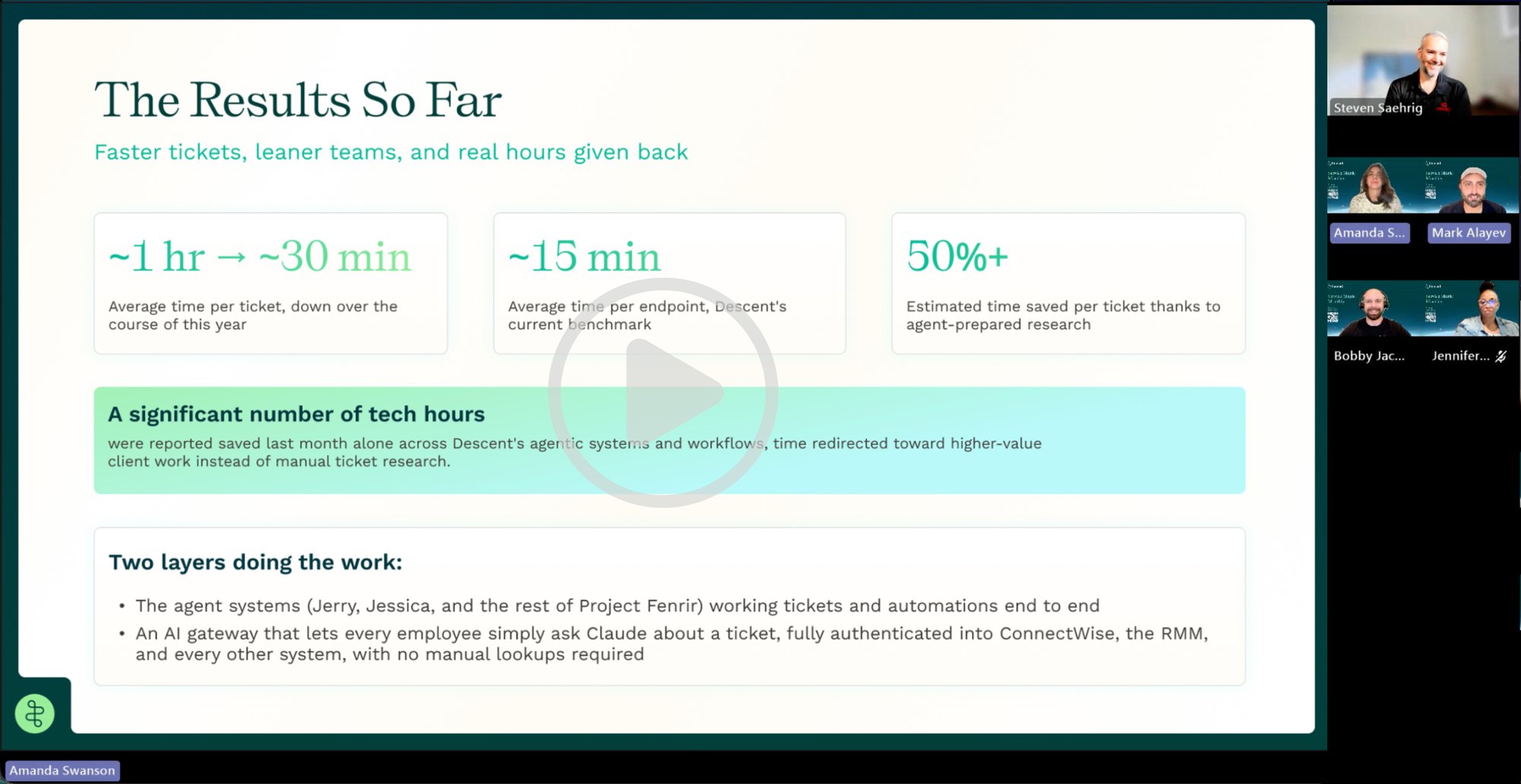
Steven explained the split at (09:54). He wasn't hiring entry-level techs to start Descent IT, so ticket intake had to be solid from day one. "I really wanted what you guys were delivering from an automation and integration perspective, the intake bot, being able to tune, we call him Jerry, was the most important thing for us right off the gate. It was the thing that allowed other things to start happening, because we didn't spend the time building a triage agent. We spent the time tuning the triage agent with you guys."
That freed the engineers for what only Descent IT could build: Project Fenrir. Steven, at (13:01): "It's meant to be a wolf pack of agents. We built a platform that's an entire agentic team that takes it from the step three point Bobby's talking about. Escalation of the ticket, reviews the content, does investigation research for us, looks at ticket history, connects to the RMM and gets endpoint details."
His rule for where the line sits, at (21:31): "The things we build are the things we cannot buy. The things we shouldn't buy, because it's how we do it. It's our approach, it's our tool, it's our custom tweak. There's no current platform that does it. That's the only time that's our line. Is there a platform I can buy to do this? If the answer's no, I'm going to build it."
Bobby pushed on this at (22:05): "Are you turning down opportunities to sell AI and automation to your customers, even with the team and the tech stack you have?" Steven: "Yeah, I say no all the time." His reasoning: pulling those two engineers onto a side project doesn't just cost the hours, it distracts from the thing that's actually driving the company forward. The distraction costs more than the time does.
Steven runs the numbers monthly. Descent IT spends about $3,500 a month across its AI stack, including full Claude access for the whole team. In a single month, that spend returned 350 hours of work nobody had to do by hand. "That's a seven times return on my cost," Steven said at (26:21). Ticket handling time fell from roughly an hour per ticket at the start of the year to under half an hour now, and Steven was careful to note the quality of the work went up too, not just the speed.
Steven's closing point, at (28:53), is the one worth sitting with: "Everyone should be thinking about how we're using AI to augment our people to make them faster, smarter, more effective. It's not about doing less, it's about doing more throughput with the same amount of time and the same amount of people."
Most MSPs don't have two AI engineers and eighteen months to spend building a research and escalation layer like Project Fenrir. They don't need to. A meaningful piece of what Fenrir does, pulling ticket history, connecting to your PSA and documentation, giving your team the context to act instead of investigate, is already built. It's called Super Magic.
See what Super Magic can take off your plate.
MSP service desk triage automation keeps underperforming for three specific reasons — and none of them are the AI itself. Here's what to fix first.
Discover the crucial difference between agentic AI and automation for MSPs, and learn how to choose the right tools for efficient service management.
Celebrating the 2025 Thready Award winners for innovative AI and automation in service desks, highlighting excellence in inbox transformation,...