Product Update
Introducing Super Magic
Thread releases Super Magic, the agentic AI that transforms IT support by automating ticket management, enhancing efficiency, and reducing technician...
Every email ticket that comes in triggers the same expensive sequence: read it, figure out what's being asked, decide who owns it, assign it, wait for a response, follow up when nothing comes back, and somewhere in the middle of all that, try to actually fix the problem.
Email support doesn't just add time. It caps capacity. A tech working email-based tickets can handle roughly 16 in a day before the wheels come off. That's not a staffing problem. That's an architecture problem. And it's invisible precisely because it looks like a normal workday.
The MSPs pulling ahead aren't the ones hiring faster. They're the ones changing the channel.
Thread pulled data across 36,000+ tickets to see what happens to response time when you change how your customers reach you.
The results aren't close.
Email with human-only support: average first human response of 222 minutes. That's over three and a half hours before anyone acknowledges the ticket — and that number excludes the automated PSA confirmation. It's three and a half hours before a person says anything.
Chat with human-only support, no triage agent involved: average first response drops to 13.5 minutes. Sixteen times faster than email, with the same headcount.
Add AI-powered triage to chat: response time falls under one minute.
That's not a marginal improvement. That's a different class of service. And the gap between where most MSPs are today and what's possible isn't a budget problem or a hiring problem — it's a channel problem.
If you want to understand what a fully connected chat-to-PSA setup looks like in practice, Thread's Live Chat is built specifically to meet customers where they work in Teams, Slack, or a web embed — and move every conversation directly into your service desk.
5 Star Solutions has been running a full chat-first support model for years. Chat is their Tier 1. Every ticket starts there.
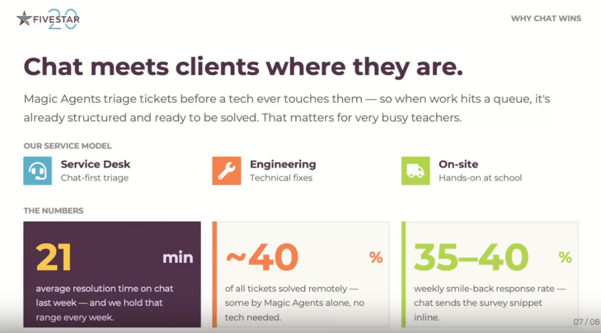
Their triage agent named Sparky handles intake, routes tickets, and sets context before a technician ever touches the conversation. The result: an average resolution time of 21 minutes on chat-only tickets, across all ticket types, including hardware. No cherry-picking.
When they rolled chat out, they didn't flip a switch. They went on-site to train end users in person and built a one-pager that eventually became a standing resource on their website. The customer education message was simple: talk to us like we're sitting in front of you. The technology isn't the point. The speed is the point.
The technician side was just as intentional. New techs shadow experienced ones inside Thread Inbox until the workflow clicks. Features like AI-generated time entries and ticket summaries turned what could have been a disruption into something people actually wanted to use.
Their CSAT response rate through chat consistently runs 40–50%. That's not a support metric. That's a relationship signal.
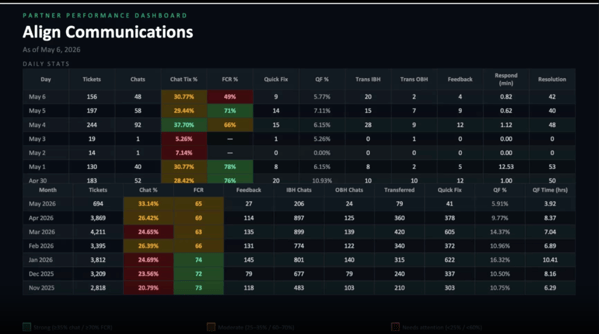
Align Communications still offers email and voice. Chat now accounts for 30% of their total ticket volume (up from 5–10% when they started) and that number keeps climbing. They don't use a triage agent. Every chat that comes in is touched by a live engineer.
Their response time via chat averages one to one and a half minutes. Resolution runs 20 to 40 minutes depending on volume and complexity.
The efficiency difference between their chat workflow and their email workflow is stark. On a single day this past May, 92 chats came in, 40% of their total volume and two and a half people handled it. The remaining 60% of volume, flowing through email, required 13 people.
That ratio is the argument. Two and a half versus thirteen. Same ticket resolution. Completely different cost structure.
Their adoption playbook: onboard new clients directly into chat with a demo call and show them the numbers. Financial services clients respond well to data. Response time comparisons close the conversation.
Most MSPs who haven't deployed chat aren't waiting on budget or technology. They're waiting on certainty that it won't blow up.
The fear is understandable. You've built a support operation that works. Your customers know the workflow. Your technicians know the workflow. Changing the channel means retraining everyone, and nobody wants to be the reason service gets worse before it gets better.
Here's what both 5 Star and Align found: the resistance is almost always front-loaded.
Customers are skeptical the first time. They've been burned by chat widgets that go nowhere — retail and telecom chat that sits idle for 48 hours before anyone responds. The expectation is low. Then they send a message and someone fixes the problem in two minutes. That's it. That's the conversion. Once they experience it, adoption follows without a sales pitch.
The internal side takes longer. Technicians need to build fluency with a new interface, develop muscle memory around new tools, and trust that the system is going to make their day easier, not harder. The teams that got this right did it by putting their best people on chat first — not their newest ones — so the first client experiences were strong, and the first technician experiences were honest representations of what the tool actually does.
Both partners gave the same advice: don't wait until you're ready. You won't be.
Start with one person. Assign ownership. Have a manager take a few chats personally before delegating anything not to monitor, but to understand. Put your strongest service person on it for the first month. Let the early adopters build the muscle before you scale.
Run a chat rotation in the beginning. Keep someone owning that queue so response times stay sharp. Then report the data back internally. Show your team — and your clients — the difference between how long chat tickets take to resolve versus email tickets. Let the numbers build the case for you.
The ramp takes time. Align dragged their feet for almost two years before committing. The thing their team said when it finally clicked: the only regret was not doing it sooner.
Here's the part that gets overlooked in the conversation about chat adoption: the clients who use chat become easier to automate.
When a client is still email-only, introducing AI-powered triage or zero-touch ticket resolution requires them to change two things at once, the channel and the experience. That's a harder sell. But a client who's been chatting with your team for six months already trusts the medium. When Sparky answers a question automatically or a password reset resolves without a technician, it doesn't feel like a loss of service. It feels like it got even faster.
Chat is how you build the foundation for Intelligent Service Delivery, the operating model where conversations, intelligence, and agents work together to deliver service that feels proactive instead of reactive. It's not the end state. It's the first layer.
Thread's automated ticket triage sits on top of the chat infrastructure, reading intent, setting fields, routing to the right team, and resolving what can be resolved without a human touch. You don't need to build toward it all at once. But you do need to start.
Most MSPs aren't one tool away from better service. They're one decision away.
The data says email is costing you hours. The MSPs who've made the switch say the only regret is waiting. The path is simple: start with one person, own the queue, show the data, and build from there.
See how Thread's chat-to-PSA setup works in practice — book a demo.
Thread releases Super Magic, the agentic AI that transforms IT support by automating ticket management, enhancing efficiency, and reducing technician...
Discover how Thread's Service Intelligence transforms service desks, turning technicians into client favorites with support through AI-driven...
Enhance customer service with AI that feels human. Discover empathetic, personalized solutions with Thread's innovative approach.