MSP Automation
Control - A Reflection of Trust - Part 3
Explore how user control over AI fosters trust in technology. Discover strategies in Thread Service Desk for enhancing agency and transparency in AI...
In the last few years, AI has boomed, expanding its influence beyond the technology industry into other sectors including government, healthcare, and education. Systems like OpenAI’s ChatGPT, Google’s Gemini, and Anthropic’s Claude have all made AI more easily accessible to the common user, which has powered AI’s growth. However, a large percentage of people in the world remain skeptical of AI systems. Some distrust AI because they are unfamiliar with how to interact with it, while others cite hallucinations or inaccuracy of AI’s answers as a friction point.
A global study by KPMG in 2025 found that 58% of people across the world actually trust AI systems (pg 27). In countries with more advanced economies, the statistic is lower than half; “two in five are willing to trust AI systems by relying on their output and sharing information with these systems” (pg 31). At Thread, we are not blind to the various reasons why many people distrust AI, but we instead embrace these systems by understanding AI’s strengths and shortcomings and acknowledging that we can play a role in sharing the knowledge of how AI actually works with our end users. We keep AI’s friction points in mind when designing for Thread Service Desk’s AI experience to help increase awareness, establish familiarity, and strengthen trust.
To reduce skepticism, we at Thread humanize the AI by making the system transparent. In the context of ethics and governance, transparency means openness and honesty, to provide a reason for the way actions and decisions are made and implemented. Adhering to this definition, the product and design team has intentionally introduced features that explain why the AI system is behaving a certain way so the user can understand more easily.
In Thread Service Desk, the technician can communicate with their client in a chat window. Before the chat thread gets assigned to the technician, AI performs some actions on the issue, including categorizing it based on issue type and prioritizing it based on urgency. Most of the time, AI is accurate in its auto-categorization and auto-prioritization, but sometimes, as with all AI systems, it can make a mistake. In this chat window, we provide plain-language summaries to inform the user the reasoning behind AI’s judgement so that when it does make a mistake, the technician can identify the root cause of the issue.
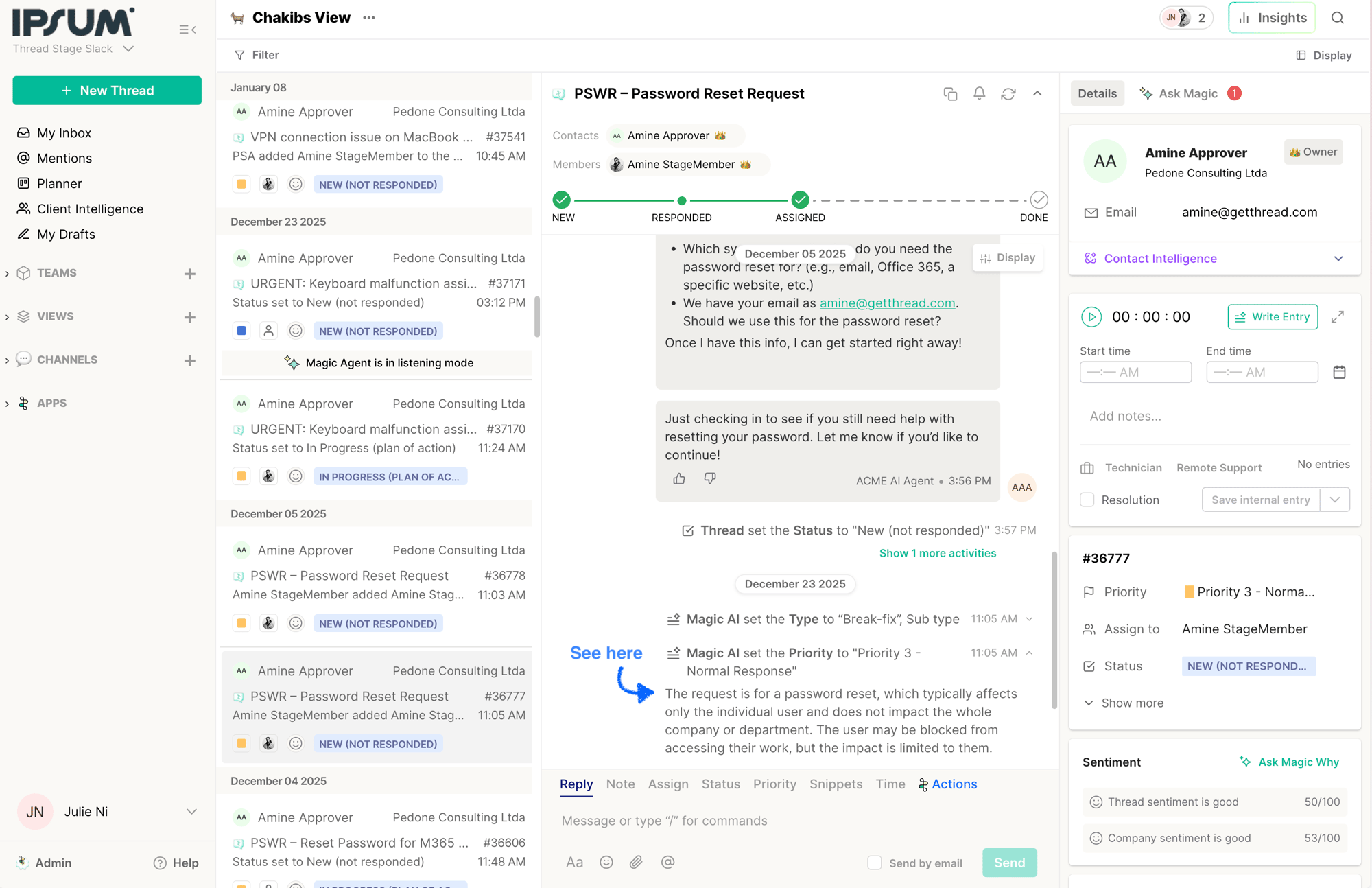
Maybe the client came in with multiple requests and the AI based the categorization off of only one of them. Perhaps the AI set the priority to a standard level because the user didn’t mention that the issue was affecting the whole company. In any case, offering an explanation helps the technician make sense of how AI is analyzing the information it reads from both the client and the technician.
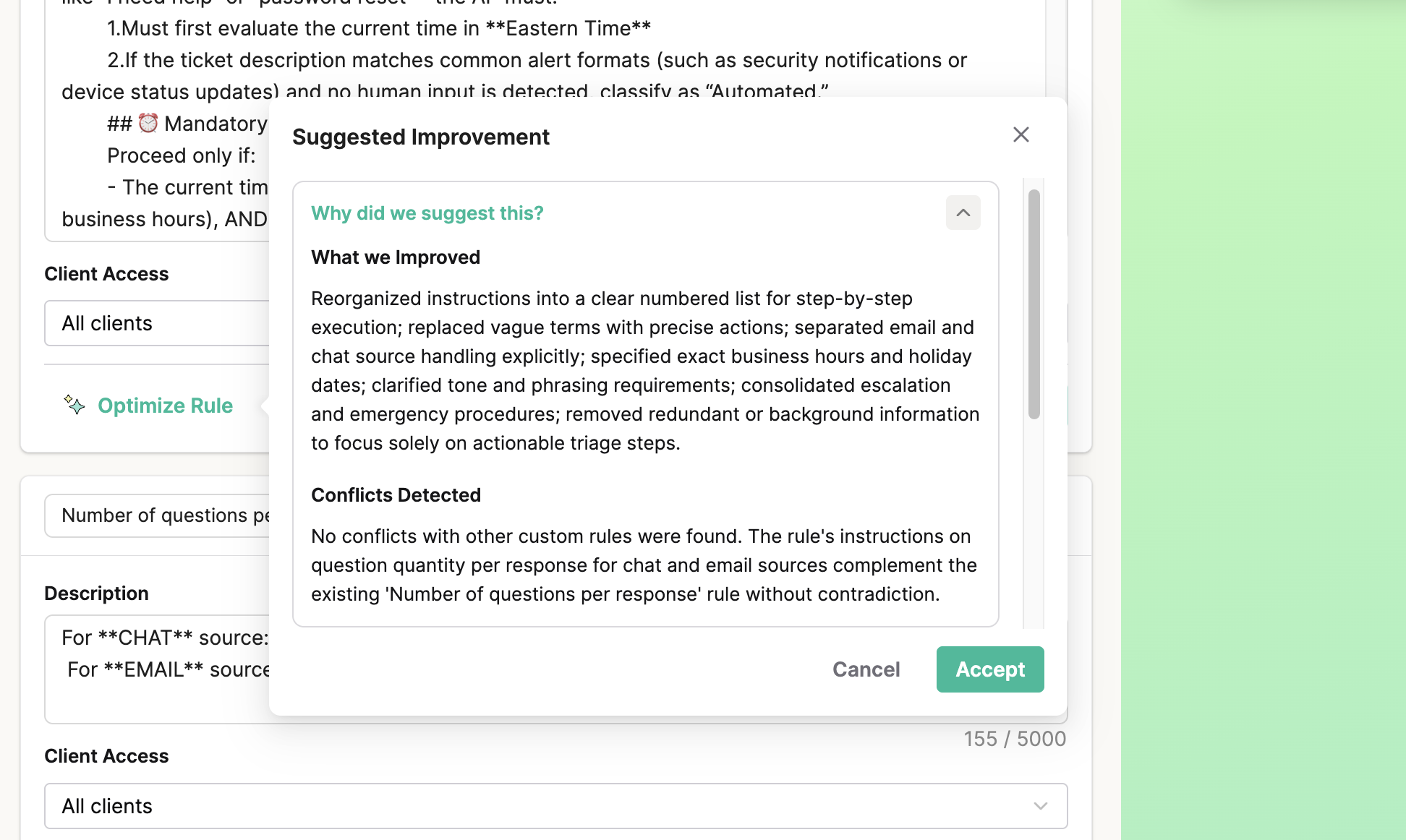
Another intentional display of transparency is in Thread Service Desk’s prompt writing section for an AI agent. When configuring an agent to carry out specific tasks and responsibilities, service desk admins have to construct the prompt in agent-friendly language. Similar to consumer AI tools like Grammarly that help anyone improve their writing grammar and style, the product and design team introduced a tool to help admins optimize their agent prompt. Instead of just rewriting the prompt for the user, we decided to craft an explanation for what we improved, why, and any conflicts we detected with other prompts so that the user has full visibility into what the revisions were and why the system may or may not work.
Finally, to bring the service desk admin user closer to the how and the why behind AI’s decision-making processes, the product and design team are also working on releasing a new feature that exposes the various justifications to the technician for why the agent generated a particular response to the client so that they not only understand the output but they can change it if desired. This new feature, launching in May 2026, will further eliminate any “black box” elements within Thread’s AI system and let our partners in on all the inner workings of AI’s “brain”. Our goal is to make the AI’s intentions clearer and more insightful, allowing admins full control in deciding whether or not they will take the AI up on its recommendations. In this manner, AI should feel like a working partner or assistant with whom one can iterate, not a black box that is never expected to make any mistakes.
The first step in building trust with AI is transparency, giving people the ability to understand how AI reaches its conclusions. When users can see where AI sources its information, they can verify accuracy and correct the model when needed.
Thread helps MSPs feel confident offering AI services to their clients by delivering features that explain why a recommendation was made and why an action was taken. We believe that making AI explainable makes it more human, and making it more human makes it more approachable and trustworthy.
But transparency alone isn't enough. Sustaining trust requires consistency, and eliminating skepticism requires giving MSPs meaningful control over AI outputs. Because trust between humans is inherently variable and nuanced, we build it incrementally — one feature, one experiment at a time.
Explore how user control over AI fosters trust in technology. Discover strategies in Thread Service Desk for enhancing agency and transparency in AI...
Explore how consistency and transparency build trust in AI service desks, enhancing user confidence and engagement through improved design and...
Revolutionize your service desk with Voice AI to transform calls into actionable data, boost efficiency, and enhance customer experience.